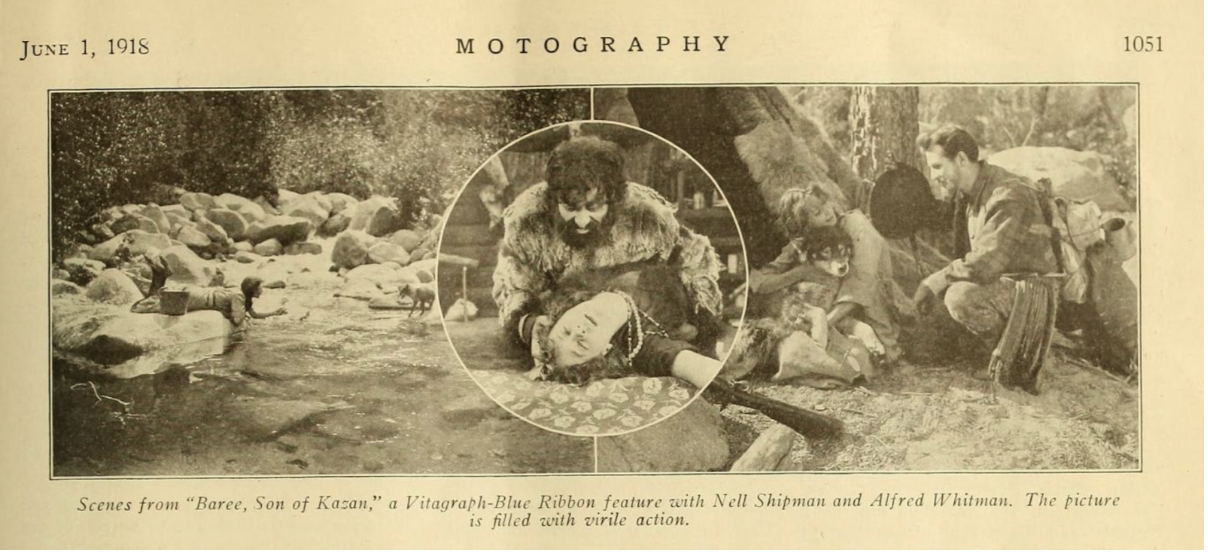
Searching for “Baree”
As we delve ever further into the growing corpus of book-to-film adaptations that form the basis of our research, it has become increasingly apparent that a troubling number of silent films featuring animal protagonists have not survived the passage of time. Many of these works are now classified as missing—presumed lost to nitrate decay, neglect, or the contingencies of early film history.
Among these casualties are two adaptations of James Oliver Curwood’s Baree, Son of Kazan: the 1918 version starring Nell Shipman and the later 1925 adaptation featuring Anita Stewart. But dear reader, we have news!
Both Curwood’s novel (1917) and its earliest film adaptation enjoyed considerable popularity upon release, benefiting from the contemporary fascination with North American wilderness adventures and coinciding with the height of Curwood’s literary career. Although strongly influenced by Jack London, Curwood’s animal narratives departed in a significant respect: where London’s wolf-dogs tend to attach themselves to male figures, Curwood’s animal heroes are notably devoted to women. This is certainly the case with Baree, who in the novel exhibits unwavering loyalty to Nepeese, a mixed-race girl persecuted by the villainous McTaggart—who murders her father and subsequently seeks to claim her for himself.
The 1918 adaptation is particularly intriguing given that Nepeese was portrayed by Nell Shipman, whose screen persona might best be described as a proto–“girl boss” heroine: resilient, armed, intrepid, and at home in the harsh terrain of snow, wilderness, and danger. Her on-screen proximity to animals was mirrored by her personal life; at one point she maintained a menagerie of over one hundred animals, including several bears. It was this distinctive interspecies intimacy that brought her into the orbit of Curwood’s work. Shipman emerged not only as an actor but also as a director and producer, entering into a short-lived partnership with Curwood to adapt his fiction for the screen. Although the collaboration was brief—only a single film ultimately resulted—it is nonetheless revealing of the era’s industrial and artistic entanglements: by the late 1910s, Curwood was already writing novels with cinematic adaptation in mind, and the transition from page to screen was often rapid and commercially strategic.
Many of Shipman’s films have been restored and made accessible through the tireless efforts of the late Tom Trusky of Boise State University. It is also at BSU that the Shipman Papers are housed (and, yes—this summer Justyna and Asia will be paying them a visit).
Justyna’s own research focuses on the animal performers in Shipman’s Back to God’s Country (1919), which has fortunately been restored and is now freely available. However, her attention soon gravitated toward the fate of the elusive Baree. She began contacting archives and institutions across Europe and North America in the hope of locating any surviving material. For a long time, these efforts led nowhere—until, unexpectedly, they yielded two extraordinary discoveries.
The Library of Congress, it turns out, holds four unpreserved nitrate reels of the 1925 Baree movie with Anita Stewart (originally released as a five-reeler), while the Eye Filmmuseum in the Netherlands has three unpreserved reels of the 1918 Baree movie with Nell Shipman. Even more encouragingly, the Library of Congress has confirmed that it can preserve these reels and make them available for onsite viewing. Meanwhile, the Eye Museum is collaborating with the Boise State University to secure funding for preserving the 1918 movie. With sufficient coordination and advocacy between institutions, there is now genuine hope that both films might be restored and reintroduced to the public.
Should this come to pass, it would represent nothing less than a crowning achievement of this project—and a remarkable recovery for silent cinema history.
And guess who's going to the Library of Congress to work with the 1925 Baree movie?
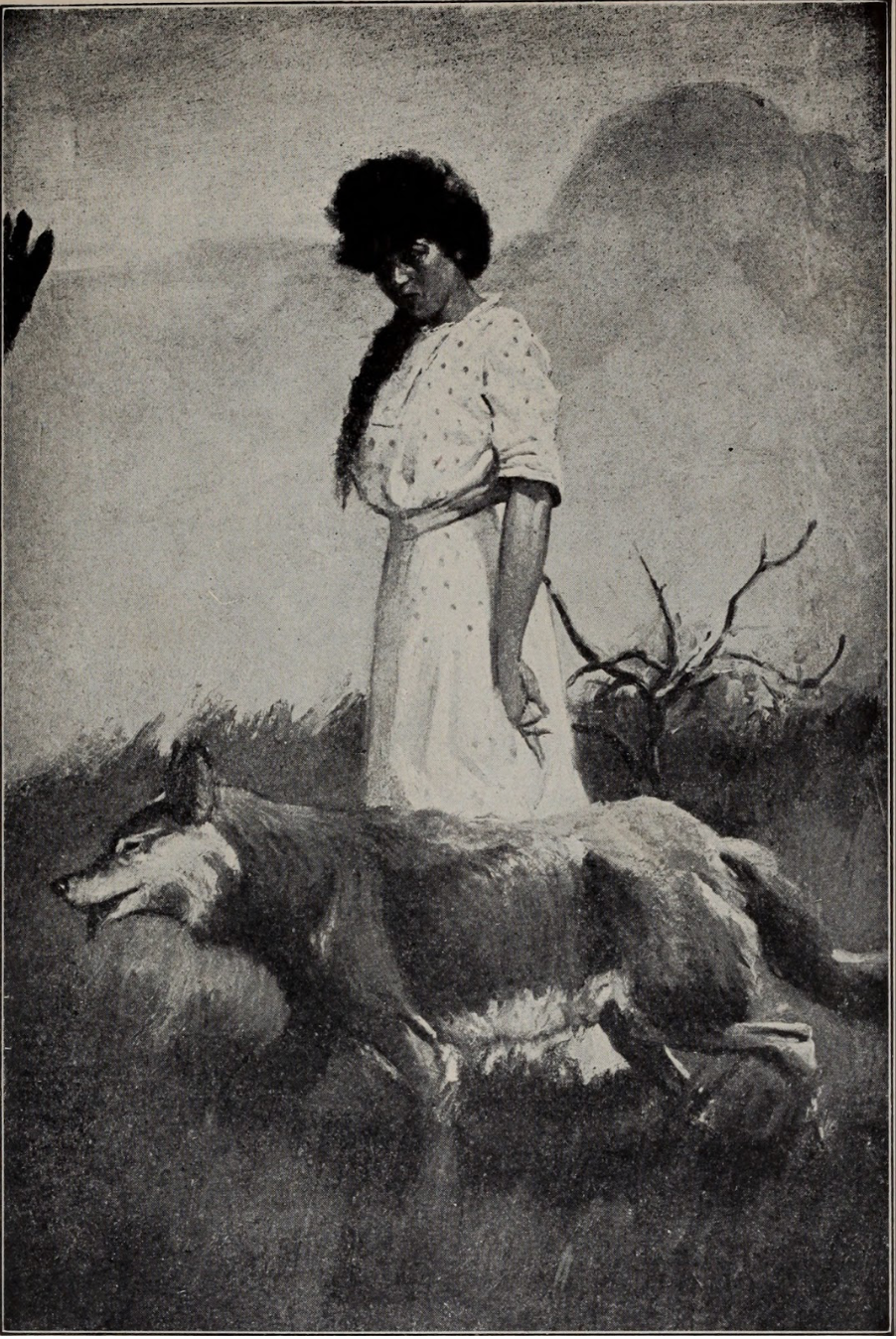
![Lobby card for the 1925 version of "Baree" with Anita Stewart [presumed lost], Wikimedia Commons](https://images.squarespace-cdn.com/content/v1/69bbe77e09f4fe2836640f95/1774004286990-6C598U84P88H5CZEZD5C/Zrzut+ekranu+2026-03-20+o+11.37.10.png)